

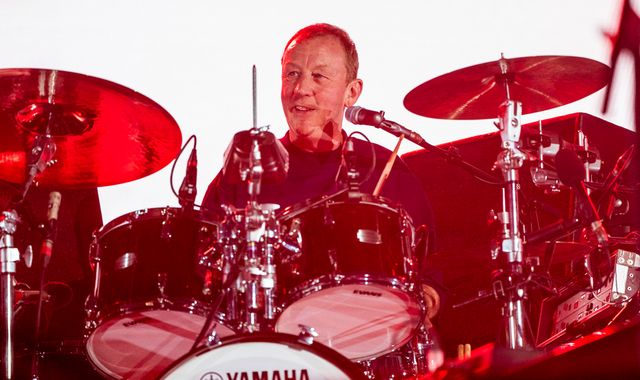
Blur star David Rowntree has lost an appeal to continue a legal case over the distribution of £200m in music royalties.
The ruling brings to an end the musician's legal claim against Performing Right Society (PRS), which collects royalties and distributes them to songwriters and producers, on behalf of 160,000 songwriters.
He claimed PRS pays "black box" royalties, also known as unidentified royalties, to producers, but not to songwriters, and argued through his lawyers that the distribution scheme was "systematically and disproportionately biased".
The number of songwriter PRS members is "far greater" than the number of publishers - more than 160,000 of the total 165,000 members - he said, and the system was potentially depriving them of up to £200m in unpaid earnings.
Rowntree's challenge was thrown out by the Competition Appeal Tribunal in August, but he then took the case to the Court of Appeal.
His lawyers told an appeal hearing earlier this month that the tribunal "erred in law", but PRS, which is not-for-profit, argued the legal action was "incoherent and discloses no arguable claim".
Court of Appeal judges have now dismissed the Blur drummer's case, writing their conclusions in a 21-page ruling.
What are black box royalties?
"Black box" royalties are those PRS collects but cannot match to a musical work or pay to an individual due to "data problems" - being unable to identify a person's payment or contact details, for example - the court was told.
The organisation then distributes the royalties "pro rata to its distribution of royalties which can be matched".
In the ruling, Lord Justice Miles said a "true" or "accurate" distribution of these royalties could not be known "because the root of the black box royalties problem is the absence of accurate information - and, conversely, if accurate information were available, the relevant royalties would be matched".
This means that no member can say they are entitled to any specific amount of those royalties.
"Once one accepts that the PRS has to adopt some rule of distribution for the black box royalties, the fairness of its chosen rule can only be assessed by comparison with some other rule," the judge added.
Read more from Sky News:
Enzo Maresca new Man City manager
Exploding 'squishy' toys warning
The ruling highlighted how a different distribution system could have a negative impact on lesser-known artists, saying it could "demonstrably favour" the "superstar writers" whose songs are widely known, giving Ed Sheeran as an example.
The judge also said Rowntree, who stood as a Labour candidate for Mid Sussex in the 2024 general election, had not offered "even a broad description" of a better or fairer way to distribute the unidentified royalties.
He continued: "In my judgment the reason why no counterfactual has been advanced, even in general terms, is manifest: it is that the very data failure problem which has given rise to the black box royalties means that there is no plausible basis for suggesting a more accurate, let alone fairer, distribution."
In a statement, Rowntree said the legal action had "succeeded in shining a light on the magnitude of PRS black box royalties".
He added that the £200m figure was "far too high, especially since I believe this money belongs overwhelmingly to individual writers rather than publishers."
The statement went on: "I would welcome the opportunity to work with the PRS to find ways to shrink the value of black box royalties for the benefit of its 160,000 songwriter members.
"There must be better ways for royalties to be identified and paid to the correct songwriter, especially given the pace at which technology is evolving.
"I would like to thank the songwriters who have written to me to express their support for this legal action, which at its heart has always been a call for greater transparency and fairness.
"The outcome of the appeal is not what I had hoped for, but of course I accept the decision of the Court of Appeal that this complaint could not be dealt with as a question of competition law."

(c) Sky News 2026: Blur drummer Dave Rowntree loses appeal to continue £200m royalties legal battle
 Dame Penelope Keith, star of The Good Life, dies aged 86
 Top Boy actor Micheal Ward 'raped woman in a car after party', court hears
 Sky under NBCUniversal umbrella in Comcast spin-off
 Harvey Weinstein will not face fourth New York rape trial